A 24-year-old music producer named James noticed something during a recording session. He kept asking his engineer to repeat themselves. He turned up his studio monitors louder than usual. At live shows, he found himself reading lips without realising it.
He assumed it was earwax. It wasn’t.
An audiogram revealed moderate bilateral sensorineural hearing loss – the kind typically seen in people three decades older. The cause: years of unprotected exposure to high-decibel music through earphones and at venues. The damage: permanent.
James’s story is not unusual. It is, increasingly, the norm.
The direct answer: Hearing loss is not primarily an old person’s condition. According to the World Health Organisation (2022), over 1.5 billion people worldwide live with some degree of hearing loss – and 430 million of them require rehabilitative care. Critically, 1.1 billion young people aged 12-35 face preventable hearing damage from recreational noise exposure alone. Hearing loss spans every age group, and the fastest-growing segment is people under 40.
- This article is for anyone who has ever turned the volume up a little too high, worked in a noisy environment, or brushed off a moment of muffled hearing as temporary. The truth about hearing loss is not what most people believe – and understanding it early could change the course of your health for life.
The Myth That’s Costing Young People Their Hearing
The cultural image of hearing loss is a white-haired grandparent cupping their ear and asking “Pardon?” That image is damaging – not because it’s offensive, but because it’s inaccurate.
It allows younger people to feel exempt. To dismiss the ringing after a concert as normal. To ignore the fact that they need subtitles for every video. To assume that straining to follow conversations in restaurants is just a quirk of the venue, not a symptom.
This denial has a measurable cost.
Research published in JAMA Otolaryngology-Head & Neck Surgery (2017) analysed National Health and Nutrition Examination Survey (NHANES) data and found that nearly 1 in 5 Americans aged 12 to 19 already shows signs of hearing loss in one or both ears – most of it attributable to recreational noise exposure. A follow-up analysis in 2022 confirmed the trend was worsening with the widespread adoption of personal audio devices.
The myth that hearing loss belongs to the elderly keeps millions of young people from taking the single most powerful action available to them: prevention, while it’s still possible.
What Hearing Loss Actually Is – A Clinical Definition
Hearing loss – also called hearing impairment or audiological dysfunction – refers to the partial or total inability to hear sounds in one or both ears. It is measured in decibels (dB) of hearing threshold loss across different frequencies (pitches), assessed through a clinical test called an audiogram.
Hearing is classified as:
| Severity | Hearing Threshold | What It Means |
| Normal | 0-25 dB | Can hear soft whispers and rustling leaves |
| Mild | 26-40 dB | Struggles with soft speech, especially in noise |
| Moderate | 41-55 dB | Difficulty with conversational speech at normal volume |
| Moderately Severe | 56-70 dB | Requires raised voice to follow conversation |
| Severe | 71-90 dB | Can only hear shouted speech or very loud sounds |
| Profound | 91 dB+ | Minimal or no usable hearing; may rely on sign language or cochlear implant |
The structure of the ear involves three regions: the outer ear (pinna and ear canal), the middle ear (eardrum and ossicles – three tiny bones), and the inner ear (cochlea and auditory nerve). Hearing loss can originate in any of these regions – and the location determines the type and treatment.
The Four Types of Hearing Loss Explained
1. Sensorineural Hearing Loss (SNHL)
The most common type. It results from damage to the hair cells of the cochlea (inner ear) or the auditory nerve. Hair cells do not regenerate – meaning SNHL is typically permanent.
Causes include: prolonged noise exposure, ageing (presbycusis), viral infections, certain medications (ototoxic drugs), and genetic conditions.
2. Conductive Hearing Loss
Caused by a physical blockage or structural problem preventing sound from reaching the inner ear. Common causes include earwax buildup, fluid in the middle ear (otitis media), perforated eardrum, or otosclerosis (abnormal bone growth in the middle ear).
Conductive hearing loss is often fully reversible with medical or surgical treatment.
3. Mixed Hearing Loss
A combination of both sensorineural and conductive components. A person might have noise-induced damage to the cochlea and a concurrent ear infection, for example.
4. Auditory Processing Disorder (APD)
A less commonly understood type where the ears function normally but the brain struggles to process and interpret auditory information correctly. APD is particularly prevalent in children and is frequently misdiagnosed as ADHD or learning disabilities.
“Auditory Processing Disorder is one of the most under-diagnosed conditions in paediatric audiology. Children are often labelled as inattentive or slow learners when the real issue is that their brain isn’t decoding sound the way it should.” – Dr. Frank Musiek, Professor of Audiology, University of Connecticut, speaking at the American Academy of Audiology Annual Conference, 2022.
Who Really Gets Hearing Loss? The Surprising Demographics
Hearing loss does not discriminate by age – though the causes shift across life stages.
Hearing Loss Prevalence in Australia by Age Group
| Age Group | Estimated Prevalence in Australia | Source |
| 0–14 years | 1 in 1,000 babies born with significant hearing loss; ~30,000 children with hearing loss overall | Hearing Australia / AIHW, 2023 |
| 12–35 years | 1.1 billion young people at risk globally from unsafe listening practices, including Australians | WHO, 2022 |
| 15–29 years | Around 1 in 6 Australians in this age group affected by noise-induced hearing loss | Deloitte Access Economics for HCIA, 2023 |
| 20–69 years | Approximately 14.5% of Australian adults report hearing loss | AIHW, 2022 |
| 65–74 years | 1 in 3 Australians affected | Hear and Say / Hearing Australia, 2023 |
| 75 years and above | 1 in 2 Australians affected | AIHW / Access Economics for Deafness Forum |
High-Risk Occupational Groups at Any Age
In Australia, certain industries carry a significantly higher risk of occupational noise-induced hearing loss. According to Safe Work Australia, prolonged exposure to noise levels exceeding 85 decibels (dB) remains the key threshold for workplace hearing damage.
High-risk industries and groups include:
- Mining, construction, and manufacturing — among the highest rates of noise exposure nationally, with workers frequently exceeding safe daily limits
- Agriculture — tractor and machinery noise is a leading cause of hearing loss in rural and regional workers
- Defence force personnel — the Department of Veterans’ Affairs (DVA) lists noise-induced hearing loss as one of the top accepted disability conditions among Australian veterans
- Entertainment and hospitality — musicians, venue staff, and nightclub workers face repeated harmful noise exposure; WorkSafe Victoria and equivalent state bodies have issued specific noise management guidelines for these workplaces
Noise-Induced Hearing Loss – The Modern Epidemic
Noise-induced hearing loss (NIHL) occurs when loud sounds damage or destroy the sensory hair cells inside the cochlea. Unlike most cells in the body, cochlear hair cells cannot repair or regenerate. Once gone, they are gone.
How Loud Is Too Loud?
Sound intensity is measured in decibels (dB). The relationship between sound level and hearing damage is not linear – it is exponential. Every 3 dB increase doubles the sound intensity. Here’s a practical reference:
| Sound Source | Approximate dB Level | Risk to Hearing |
| Normal conversation | 60 dB | Safe indefinitely |
| City traffic | 80-85 dB | Safe for up to 8 hours |
| Lawnmower / busy restaurant | 85-90 dB | Damage possible after 2 hours |
| Earphones at 80% volume | 94-100 dB | Damage possible after 1 hour |
| Live concert / nightclub | 100-110 dB | Damage possible after 15 minutes |
| Motorbike without helmet | 100 dB | Damage possible after 15 minutes |
| Gunshot / fireworks | 140-165 dB | Instantaneous damage possible |
The WHO Safe Listening Guidelines (2022) recommend a maximum of 80 dB for 40 hours per week for recreational listening – and no more than 85 dB in occupational settings without hearing protection.
The Problem with Earphones and Earbuds
Personal audio devices have fundamentally changed the hearing loss risk landscape. The adoption of in-ear earphones (which deliver sound directly to the eardrum canal at closer range) rather than over-ear headphones has increased effective sound pressure levels reaching the cochlea.
According to a systematic review published in BMJ Global Health (2022), approximately 50% of teenagers and young adults in high- and middle-income countries use personal audio devices at unsafe volumes or durations. The review estimated 1.35 billion people could be at risk of hearing damage from this habit alone.
Early Warning Signs Most People Dismiss
Hearing loss is rarely sudden (unless caused by acoustic trauma or sudden sensorineural hearing loss – a medical emergency). It creeps in quietly, and the brain adapts – filling in gaps, favouring familiar voices, unconsciously lip-reading. This compensation mechanism is sophisticated enough to delay self-awareness by years.
Watch for these early signs – in yourself or someone you care about:
Auditory Signs:
- Frequently asking others to repeat themselves
- Difficulty following conversations in noisy environments (restaurants, parties)
- Turning up the TV or radio louder than others prefer
- Mishearing words – especially consonants like S, F, TH, SH (high-frequency sounds go first)
- Tinnitus – persistent ringing, buzzing, hissing, or clicking in one or both ears
- Feeling like people are mumbling, even when they’re speaking clearly
- Difficulty hearing on phone calls
Behavioural Signs:
- Avoiding social situations because conversation is exhausting
- Nodding and smiling without fully following what’s being said
- Preferring one ear over the other on phone calls
- Struggling in meetings or lectures despite sitting close to the speaker
- Lip-reading more than you’ve ever noticed before
“One of our readers, Tasneem from Dandenong, wrote to us: ‘I thought I was just getting tired at parties and tuning out. It took my colleague pointing out that I never heard her approaching from my right side before I realised something might be wrong. I was 31. I had moderate high-frequency loss in both ears.'”
Tinnitus in particular deserves special attention. It is not a disease itself but a symptom – frequently the earliest detectable sign of cochlear hair cell damage occurring before any measurable hearing threshold shift. If you experience persistent tinnitus, treat it as a warning signal, not a nuisance.
How Hearing Loss Affects Your Brain, Mood, and Life
The consequences of untreated hearing loss extend far beyond not hearing clearly. The brain’s auditory cortex is not a passive receiver – it is an active, resource-intensive processor. When input degrades, the effects cascade.
Cognitive Decline and Dementia
The Lancet Commission on Dementia Prevention, Intervention, and Care (2020) identified hearing loss as the single largest modifiable risk factor for dementia, accounting for approximately 8% of all dementia cases globally. The proposed mechanisms include:
- Cognitive load theory: Straining to decode degraded auditory signals consumes cognitive resources that would otherwise support memory and executive function.
- Social withdrawal: Hearing loss reduces social engagement, a key protective factor for cognitive health.
- Auditory deprivation: Reduced stimulation of the auditory cortex may accelerate brain atrophy in regions linked to memory.
A Johns Hopkins University study led by Dr. Frank Lin (2011, JAMA) found that individuals with mild hearing loss were twice as likely to develop dementia, those with moderate loss were three times as likely, and those with severe loss were five times as likely as those with normal hearing.
Critically, a landmark 2023 clinical trial published in The Lancet – the ACHIEVE study – found that treating hearing loss with hearing aids in cognitively at-risk older adults reduced the rate of cognitive decline by 48% over three years.
Mental Health: Depression and Anxiety
According to the National Institute on Deafness and Other Communication Disorders (NIDCD, 2021), adults with hearing loss are significantly more likely to report depression, anxiety, and social isolation than age-matched peers with normal hearing. The pathway is intuitive: communication difficulty breeds frustration, social withdrawal, and reduced participation in activities that once brought joy.
Academic and Professional Impact
In children, even mild hearing loss of 15-25 dB can cause measurable academic disadvantage – affecting language development, phonological awareness, reading fluency, and classroom participation. A study in Pediatrics (2015) found that children with undetected mild hearing loss were significantly more likely to repeat a grade.
For working adults, a report by the Hear the World Foundation (2017) found that individuals with untreated hearing loss earned on average $30,000 less annually than hearing peers with similar qualifications – largely due to reduced workplace effectiveness and career advancement.
Hearing Loss in Children and Teenagers
Hearing loss in young people is particularly consequential because the auditory system and brain are still developing. Early identification and intervention are critical.
Congenital Hearing Loss
According to Hearing Australia (2023), approximately 1 to 2 in every 1,000 newborns in Australia are born with a permanent hearing loss, making it one of the most common congenital conditions identified at birth.
Australia has made significant progress in early detection through the Universal Newborn Hearing Screening (UNHS) program, which is available in all states and territories. The program uses automated auditory brainstem response (AABR) testing, typically conducted before hospital discharge, to identify hearing loss as early as possible in a child’s life.
Acquired Hearing Loss in Children
After birth, children can develop hearing loss from:
- Recurrent otitis media (middle ear infections) – the most common cause of temporary hearing loss in children globally
- Meningitis and encephalitis – can damage the cochlea rapidly
- Ototoxic medications – including certain antibiotics (gentamicin) and chemotherapy drugs (cisplatin)
- Head trauma
- Noise exposure – increasingly, from earphones, gaming headsets, and unprotected attendance at live events
Teenagers and the Earphone Crisis
A cross-sectional study published in JAMA Otolaryngology (2022) found that adolescents who reported using earphones daily at high volumes were 35% more likely to show audiometric evidence of noise-induced damage compared to those who used them rarely. The pattern was consistent across countries and income levels.
The irony is that teenagers – the most culturally resistant group to health warnings – are currently the age group most rapidly accumulating the kind of noise exposure that will manifest as hearing loss in their 30s and 40s.
When to See an Audiologist – and What to Expect
An audiologist is a healthcare professional specialising in the assessment, diagnosis, and non-medical treatment of hearing and balance disorders. They hold a Doctor of Audiology (AuD) degree or equivalent.
When to Book an Appointment
- You regularly ask people to repeat themselves
- Others comment that you have the TV too loud
- You have persistent tinnitus (lasting more than a week)
- You struggle to follow conversations in background noise
- You notice a difference in hearing between ears
- You’ve had significant noise exposure (occupational or recreational)
- You’re over 50 and haven’t had a hearing test in 5+ years
What an Audiology Appointment Involves
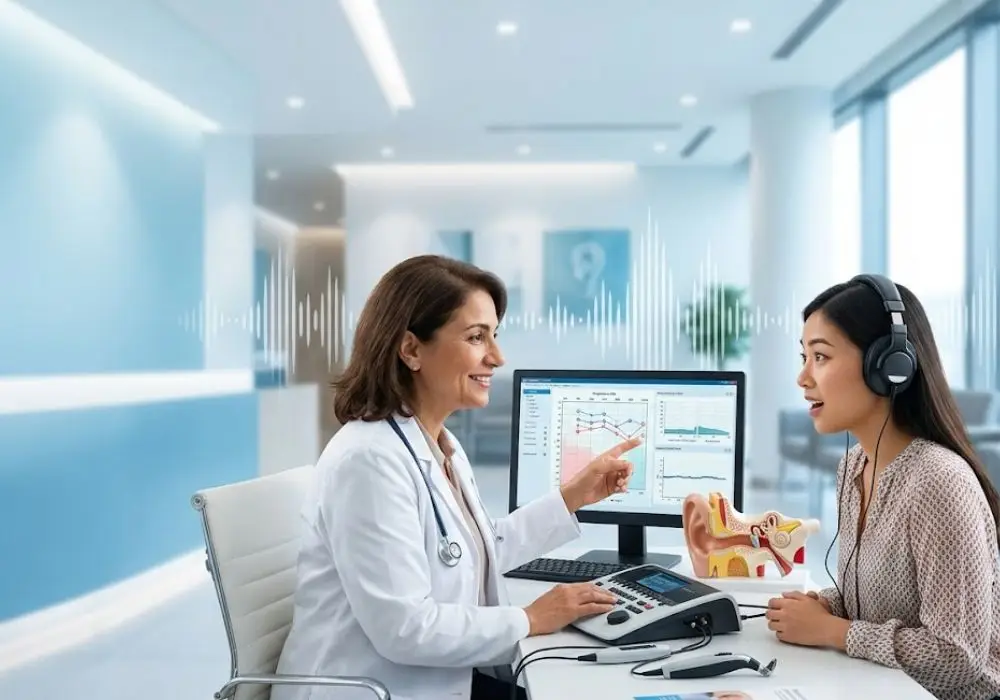
Pure Tone Audiometry: You sit in a soundproof booth and press a button each time you hear a tone through headphones. This maps your hearing sensitivity across frequencies (250 Hz-8,000 Hz) in each ear. The result is an audiogram – a visual graph of your hearing thresholds.
Speech Audiometry: Tests how well you can understand speech at different volume levels – assessing not just hearing sensitivity but auditory processing ability.
Tympanometry: A probe is placed gently in the ear canal to measure eardrum movement and middle ear pressure. This identifies conductive problems, fluid, or eardrum perforations.
Otoacoustic Emissions (OAE) Testing: Measures sound emitted by healthy cochlear hair cells in response to a stimulus. Absent OAEs indicate hair cell damage – a sensitive early marker of sensorineural loss.
Treatment Options: From Hearing Aids to Cochlear Implants
Hearing Aids
Modern hearing aids are extraordinarily sophisticated – far removed from the bulky, whistling devices of a generation ago. Today’s devices are:
- Discreet or invisible – completely-in-canal (CIC) aids sit entirely inside the ear canal
- Bluetooth-enabled – streaming directly from smartphones, TVs, and computers
- AI-powered – automatically adjusting to different listening environments in real time
- Rechargeable – no more fumbling with tiny batteries
Hearing aids are indicated for mild to severe hearing loss. They do not restore normal hearing – they amplify and process sound to make it more accessible. According to the ACHIEVE Study (The Lancet, 2023), consistent hearing aid use in eligible adults also carries the cognitive protective benefit mentioned earlier.
Cochlear Implants
For individuals with severe-to-profound sensorineural hearing loss who don’t benefit sufficiently from hearing aids, cochlear implants are the gold standard intervention. A cochlear implant bypasses damaged hair cells entirely, directly stimulating the auditory nerve with electrical signals via an electrode array surgically inserted into the cochlea.
According to the NIDCD (2023), more than 700,000 cochlear implants have been implanted worldwide. Success rates in post-lingual adults (those who lost hearing after developing speech and language) are very high, with most recipients reporting significant improvements in speech understanding.
Bone-Anchored Hearing Aids (BAHA)
For conductive or mixed hearing loss – particularly in patients with ear canal abnormalities – bone-anchored devices transmit sound vibrations through the skull directly to the cochlea, bypassing the outer and middle ear entirely.
Medical and Surgical Options
- Ear syringing/microsuction – for wax-related conductive loss
- Grommets (tympanostomy tubes) – for recurrent otitis media with effusion in children
- Stapedectomy – surgical correction of otosclerosis
- Sudden sensorineural hearing loss – treated with high-dose oral or intratympanic corticosteroids as a medical emergency. Time-critical: best outcomes when treated within 72 hours of onset.
7 Evidence-Based Ways to Protect Your Hearing Starting Today
- Follow the 60/60 rule for personal audio. Listen at no more than 60% of maximum volume for no more than 60 minutes at a time. This WHO-recommended guideline applies to all earphones and headphones.
- Use over-ear headphones rather than in-ear earbuds where possible. Over-ear designs reduce the effective dB level reaching the eardrum, and their passive noise isolation means you need less volume to hear clearly.
- Wear custom earplugs at live events and in loud workplaces. Custom musician’s earplugs (made by an audiologist from an ear impression) reduce volume evenly without distorting sound quality – unlike foam plugs that muffle. They cost approximately £100-£200 but last years.
- Take “hearing breaks.” After prolonged noise exposure, give your ears quiet recovery time. Temporary threshold shifts (the muffled hearing after a concert) are a sign of stress on cochlear hair cells – recovery requires silence.
- Get a baseline hearing test. If you’ve never had one, book one now. Knowing your baseline allows you to detect changes in future years. Many audiologists offer free or subsidised initial screenings.
- Monitor your listening environment with a sound level app. Free apps like NIOSH SLM (iOS/Android) measure real-time decibel levels in your environment. Use it in restaurants, gyms, and workspaces to understand what you’re actually exposed to.
- Act on tinnitus immediately. Persistent ringing or buzzing after noise exposure is your cochlea’s distress signal. Reduce your noise exposure, avoid further loud sounds for several days, and consult an audiologist if the ringing persists beyond 48-72 hours.
Common Myths About Hearing Loss, Debunked
Myth 1: “Hearing loss only affects old people.”
False. As this article has established, 1.1 billion young people are currently at risk, and nearly 1 in 5 teenagers already shows audiometric evidence of hearing damage.
Myth 2: “If I had hearing loss, I’d know it.”
False. Hearing loss is gradual. The brain compensates powerfully. Most people with mild-to-moderate loss are unaware until a hearing test reveals it. The average person waits 7-10 years before seeking help.
Myth 3: “Hearing aids make you look old – I’d rather just turn things up louder.”
Outdated and dangerous. Modern hearing aids are barely visible. And turning things up louder is self-defeating – you’re compensating for loss by adding more exposure, potentially accelerating further damage.
Myth 4: “Loud sounds only damage your hearing if they hurt.”
False. Sound doesn’t have to be painful to be damaging. Hair cell damage occurs at sustained levels above 85 dB – levels that most people find merely loud, not uncomfortable. Pain is not a reliable indicator of safety.
Myth 5: “Earwax causes permanent hearing loss.”
Mostly false. Earwax causes conductive (temporary) hearing loss and is almost entirely reversible with removal. Never use cotton swabs inside the ear canal – they compact wax deeper and can perforate the eardrum. Use olive oil drops or see a clinician for microsuction.
Myth 6: “There’s nothing you can do about hearing loss.”
False. Many types are preventable. Conductive causes are often treatable. Sensorineural loss – the most common type – can be effectively managed with hearing aids or cochlear implants that dramatically improve quality of life and cognitive outcomes.
FAQ
Q1: Can hearing loss be reversed or cured? It depends entirely on the type. Conductive hearing loss – caused by wax, fluid, infection, or structural issues – is usually reversible with medical or surgical treatment. Sensorineural hearing loss (damage to cochlear hair cells) is currently permanent, as human hair cells do not regenerate. However, hearing aids and cochlear implants can restore significant functional hearing. Ongoing research into hair cell regeneration using gene therapy shows early promise but is not yet clinically available.
Q2: At what age should I get my first hearing test? Newborns are screened at birth in most countries. After that, there are no universal guidelines for routine audiological screening in young adults with no risk factors, but most audiologists recommend a baseline test in your 20s or 30s, and then every 3-5 years. Anyone with occupational noise exposure, frequent loud music exposure, or a family history of hearing loss should be tested earlier and more regularly.
Q3: Is tinnitus always a sign of hearing loss? Not always – but very often. Tinnitus and sensorineural hearing loss share the same underlying cause: cochlear hair cell damage. Most people with tinnitus also have some degree of audiometric hearing loss, even if it’s not yet clinically significant. Tinnitus can also be caused by ear infections, earwax, blood pressure changes, medications, jaw problems (TMJ), or rarely, tumours on the auditory nerve (acoustic neuroma).
Q4: Can earphones cause permanent hearing loss in teenagers? Yes, they can. Sensorineural hearing loss from noise exposure is cumulative and irreversible. Teenagers who routinely listen at high volumes (above 80-85 dB) for extended periods are damaging cochlear hair cells that will never recover. The effects may not be clinically noticeable for years, but they are real and they compound.
Q5: What is sudden hearing loss and is it an emergency? Sudden sensorineural hearing loss (SSNHL) is defined as hearing loss of 30 dB or more occurring over 72 hours or less, usually in one ear. It is a medical emergency. Approximately 50,000 new cases occur in the US annually. Most cases are idiopathic (no known cause), but suspected causes include viral infection, vascular events, and autoimmune processes. Early treatment with corticosteroids (ideally within 24-72 hours) significantly improves outcomes. If you wake up with sudden hearing loss in one ear, seek emergency medical care immediately – do not wait.
Q6: Do noise-cancelling headphones protect hearing? Passive noise isolation (physical blocking of external sound) reduces the need to raise listening volume – effectively providing some hearing protection benefit. Active noise cancellation (ANC) works electronically to cancel external noise and offers a similar benefit. Both types are safer than in-ear earphones used in noisy environments without noise reduction. However, neither provides the level of protection of certified hearing protection devices.
Q7: How do I know if I need a hearing aid or a cochlear implant? Hearing aids are appropriate for mild to severe hearing loss in individuals who still have functional cochlear hair cells that can be amplified. Cochlear implants are considered for individuals with severe-to-profound sensorineural hearing loss who receive limited benefit from hearing aids. The decision is made by an audiologist and ENT surgeon following comprehensive audiological evaluation. Both options have transformed outcomes for millions of people.
Conclusion
James, the music producer from our opening story, now wears custom-moulded in-ear monitors at every session. He uses hearing aids for daily communication. He advocates loudly – in the truest sense – for hearing protection among younger musicians who think it “won’t happen to them.”
His hearing loss is permanent. His advocacy doesn’t have to be.
The truth about hearing loss is this: it is the world’s most common sensory disability, it is increasingly affecting younger people, it is largely preventable, and it is catastrophically under-addressed. The 7-10 year gap between onset and treatment is not a gap in healthcare capacity – it is a gap in awareness. It is the gap this article was written to close.
What to do right now:
- If you haven’t had a hearing test, book one – treat it as you would an eye test or dental check-up.
- If you regularly use earphones, download a sound level app and check your listening habits today.
- If you work in a noisy industry, ask your employer about hearing protection and occupational noise monitoring.
- If you have tinnitus, stop dismissing it and speak to an audiologist.
Your hearing is one of the few senses you can actively protect – but only before the damage is done.
About the Author
Dr Vasuthan Sellathurai, affectionately known as Dr Vasu, is an experienced General Practitioner with over 15 years in the medical field. He holds a Bachelor of Medicine / Bachelor of Surgery (MBBS) and is a Fellow of The Royal Australian College of General Practitioners (FRACGP). Dr Vasu’s special interests include dermatology, skin cancer medicine, and surgery, offering services such as skin checks and removal of skin lesions. He is dedicated to providing the highest quality of care to the Dandenong community
Learn More: https://gcmcd.com.au/our-doctors/dr-vasuthan-vasu
Sources & References
- World Health Organisation – World Report on Hearing, 2021. who.int/publications/i/item/world-report-on-hearing
- WHO – Make Listening Safe, Safe Listening Guidelines, 2022. who.int/activities/making-listening-safe
- Livingston, G. et al. – Dementia prevention, intervention, and care: 2020 report of the Lancet Commission. The Lancet, 2020.
- Lin, F.R. et al. – Hearing loss and incident dementia. JAMA Internal Medicine (formerly Archives of Internal Medicine), 2011.
- Deal, J.A. et al. – Effect of a Hearing Intervention on Cognitive Decline in Older Adults with Hearing Loss. The Lancet (ACHIEVE Study), 2023.
- Bigelow, R.T. et al. – Association of Leisure-Time Physical Activity and Hearing Loss. JAMA Otolaryngology-Head & Neck Surgery, 2017.
- National Institute on Deafness and Other Communication Disorders (NIDCD) – Noise-Induced Hearing Loss, 2022. nidcd.nih.gov
- Centers for Disease Control and Prevention (CDC) – Occupational Hearing Loss, 2023. cdc.gov/niosh/topics/noise